The Essential Tire Maintenance Guide: Pressure, Alignment, Rotation, and DIY Tools
Most tire problems that feel sudden — a blowout, a tire worn bald months before it should be, or a car that pulls to one side — aren't sudden at all. They're the slow result of a handful of maintenance basics that got skipped: pressure that drifted out of spec, rotations that got pushed off, or an alignment issue nobody caught because nothing felt obviously wrong.
This guide covers the four factors that actually determine how long your tires last and how safely they perform: maintaining cold inflation pressure, performing routine rotations, correcting wheel alignment, and having the right tools on hand for home service.

Tire Pressure: The Single Most Impactful, Most Ignored Maintenance Item
Correct tire pressure is free to maintain and has an outsized effect on tread wear, ride quality, braking distance, and fuel economy. Yet it's the item most drivers check least — often only when a dashboard warning light forces the issue, at which point the tire may have already been running dangerously low for weeks.
Where to Find Your Actual Spec — and Where Not to Look
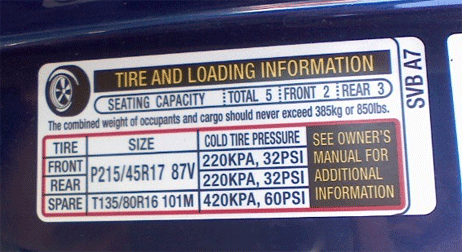
The correct pressure for your vehicle is printed on a placard sticker inside the driver's door jamb, not molded into the tire sidewall. This distinction trips up more people than almost anything else in tire maintenance. The number on the sidewall is the tire's maximum safe pressure ceiling, not the recommended operating target.
The door jamb sticker reflects what the vehicle manufacturer engineered the suspension, braking, and handling around for that specific car model. It is frequently lower than the tire's max rating by 10 PSI or more. Always set your pressure to the door jamb specification and always check cold — before driving more than a mile, as driving heats the air inside and produces an artificially high reading.
Why Overinflation and Underinflation Cause Different Damage
These aren't just two versions of "wrong" — they cause distinct, opposite wear patterns and different safety risks:
| Factor | Overinflation | Underinflation |
|---|---|---|
| Tire Behavior | Center bulges; carries most of the vehicle load | Tire flattens; outer shoulders carry the load |
| Wear Pattern | Center tread wears significantly faster than edges | Both outer edges wear faster than center tread |
| Handling Impact | Harsh ride, stiff impact, reduced wet traction | Sluggish steering, excessive sidewall flex & heat |
| Hidden Safety Risk | Reduced contact patch during emergency stops | Internal carcass damage and belt separation |
Underinflation is the far more common real-world issue. Tires naturally lose roughly 1 PSI per month via rubber permeability, plus another 1 PSI for every 10°F drop in ambient temperature. A tire set correctly in August can be severely underinflated by winter with no puncture or leak involved.
A Word on TPMS (Tire Pressure Monitoring System):
Your dashboard warning light is a safety backstop, not a replacement for routine checks. Federal standards only require TPMS to illuminate after pressure drops 25% below placard spec. By the time the light triggers, your tire has been running severely underinflated for weeks. Verify pressure manually with a quality gauge monthly.
Alignment: The Problem Pressure Checks Won't Catch
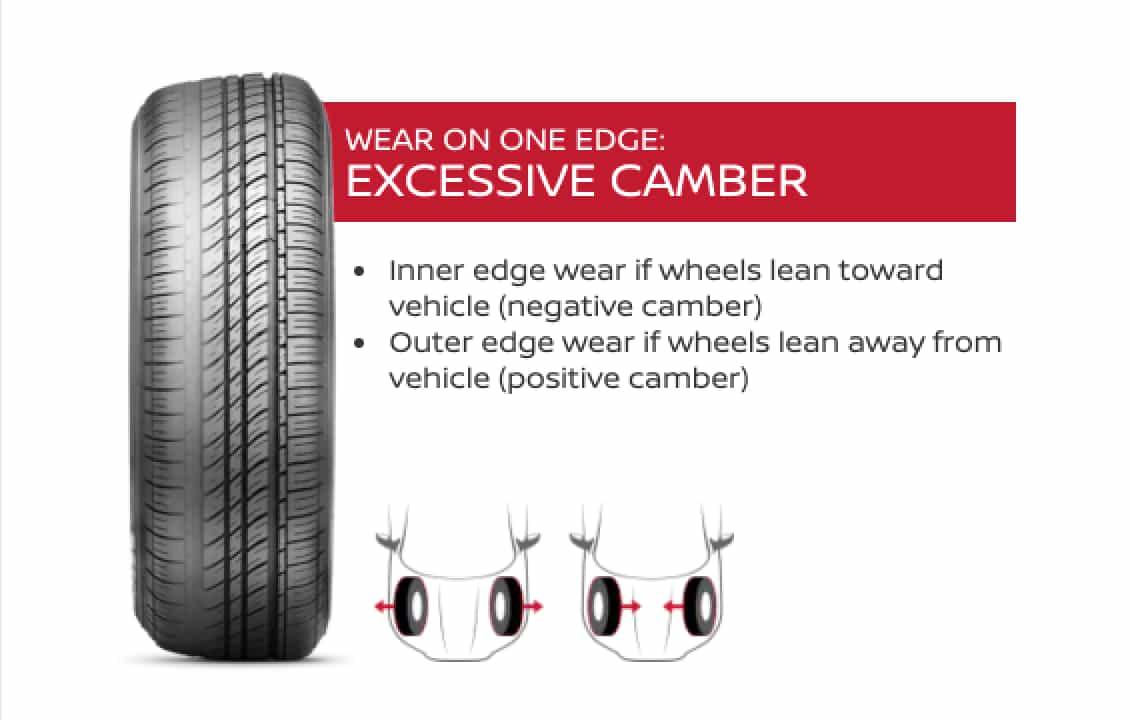
Wheel alignment refers to the geometric angles at which your tires contact the road — camber, toe, and caster. When these angles knock out of factory spec, the tire drags or leans unevenly across the road surface regardless of correct inflation pressure.
Real-World Realization:
A driver running premium all-season tires wore the inner shoulders down to the steel belts in under 18,000 miles while the center tread showed 6/32" remaining. An alignment check revealed -2.4 degrees of excessive negative camber. Checking tire pressure alone would never have caught this failure.
Schedule an alignment check immediately if you notice sharp edge wear, if the steering wheel stays off-center, if the vehicle drifts on straight highways, or after striking a deep pothole or curb. As preventative maintenance, inspect alignment yearly.
Rotation: Evening Out Wear You Can't Fully Prevent
Front tires on front-wheel-drive and all-wheel-drive vehicles handle steering forces, cornering loads, and the majority of braking weight, typically wearing two to three times faster than rear tires. Systematic tire rotations redistribute those mechanical loads, extending overall tread life by 20% to 30%.
| Drivetrain Configuration | Recommended Rotation Pattern |
|---|---|
| Front-Wheel Drive (FWD) | Forward Cross (Fronts straight back, rears crossed to front) |
| Rear-Wheel Drive (RWD) / 4WD | Rearward Cross (Rears straight forward, fronts crossed to rear) |
| All-Wheel Drive (AWD) | X-Pattern / Double Cross (All corners swapped diagonally) |
| Directional Tread Tires | Same-side Front-to-Back (Maintain rolling direction arrow) |
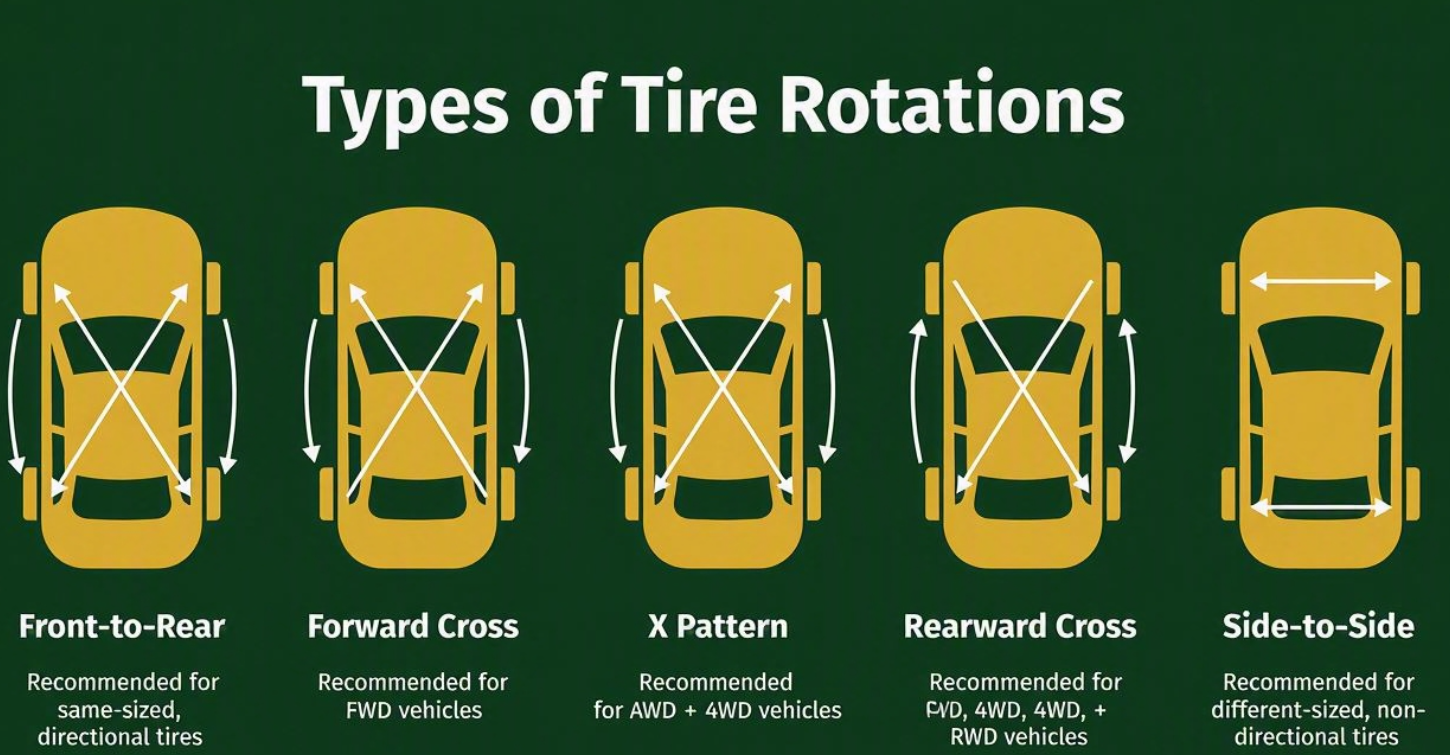
Rotate tires every 5,000 to 7,500 miles — or conveniently alongside every routine engine oil change.
Essential Tools for Home Tire Maintenance
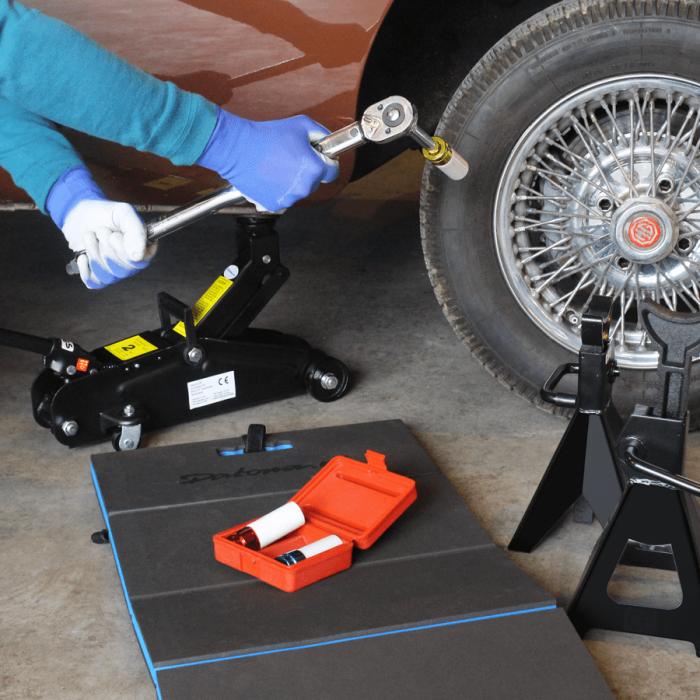
Performing your own tire rotations or winter wheel swaps requires a basic, high-quality set of tools to ensure vehicle stability and safe wheel fastness:
| Tool | Function & Selection Tip |
|---|---|
| Hydraulic Floor Jack | Safely lifts vehicle; choose a low-profile 2.5-ton to 3-ton rating for stability over emergency scissor jacks. |
| Heavy-Duty Jack Stands | Mandatory mechanical support once raised. Never place body parts under a car supported solely by a hydraulic jack. |
| Click-Type Torque Wrench | Tightens lug nuts precisely to foot-pound spec (typically 80–100 ft-lbs). Prevents warped brake rotors and loose wheels. |
| Digital / Dial Pressure Gauge | Provides consistent cold readings within +/- 0.5 PSI compared to inaccurate gas station stick gauges. |
Pro Tip for Home Service:
Always break lug nuts loose 1/2 turn while the car tires are still firmly on the ground. Once elevated in the air, un-torquing lug nuts will simply spin the free wheel. Always perform a final click-check torque verification in a star pattern after lowering the car, and re-torque after 50–100 miles of driving.
Bottom Line
Pressure: Check monthly, cold, using the driver's door jamb spec as your target.
Alignment: Inspect yearly or whenever edge wear or highway pulling appears.
Rotation: Perform every 5,000–7,500 miles to distribute drivetrain cornering wear.
Tools: Invest in a floor jack, jack stands, and a proper torque wrench for safe DIY maintenance.